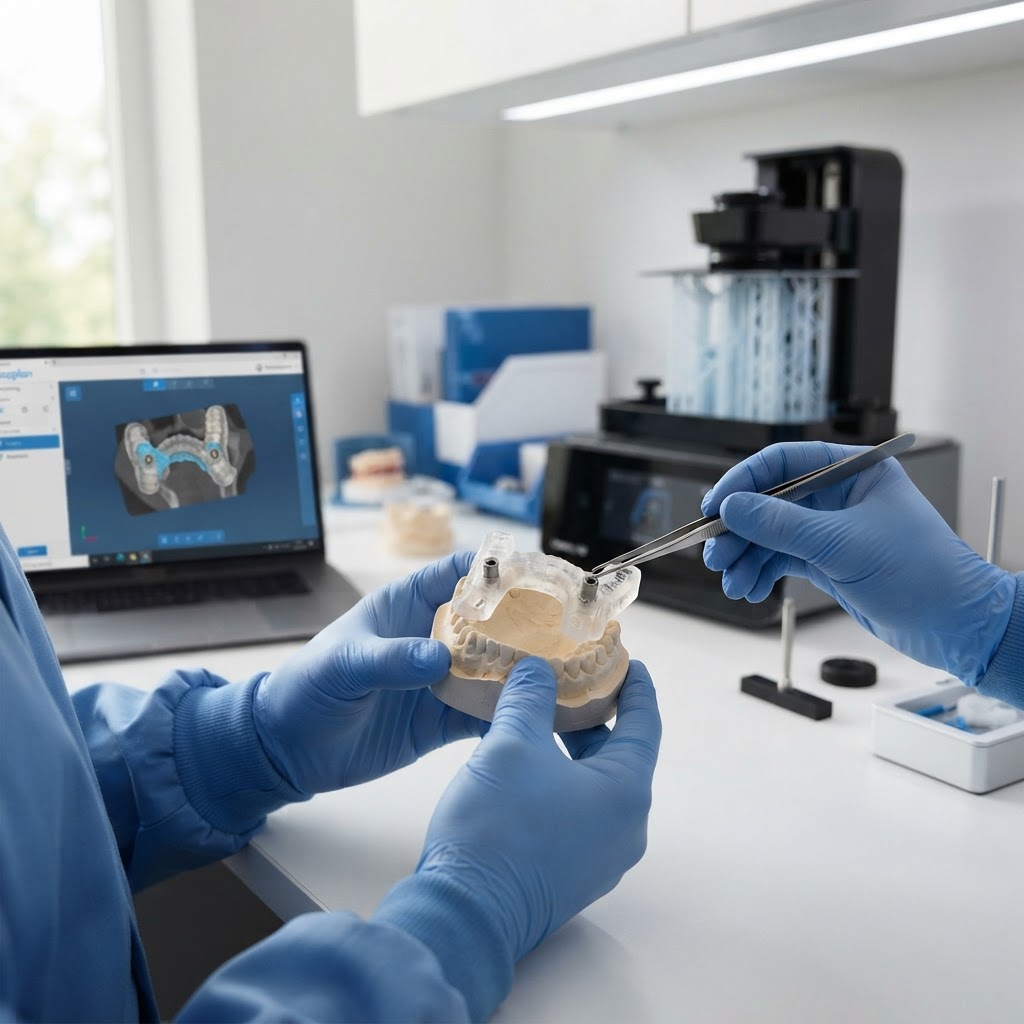
The Paradigm Shift Toward Guided Accuracy
In the rapidly evolving landscape of restorative dentistry, the transition from freehand implant placement to guided surgery represents one of the most significant leaps in clinical safety and prosthetic predictability. For the modern dental laboratory and the tech-forward clinician, surgical guides are no longer a luxury but a fundamental component of the standard of care. However, the efficacy of guided surgery is entirely dependent on the precision of the manufacturing process and the integrity of the digital workflow. As we push the boundaries of what is possible, understanding the nuances of surgical guide printing accuracy and its integration into the broader digital ecosystem is paramount.
Quantifying Accuracy: Where Do Deviations Occur?
Accuracy in guided surgery is not a single metric but the sum of various data points across the digital thread. In clinical literature, accuracy is typically measured by three primary deviations: global coronal deviation, global apical deviation, and angular deviation. While a deviation of 1.0mm at the apex might seem negligible in some contexts, in the proximity of the inferior alveolar nerve or the maxillary sinus, it can be the difference between success and a catastrophic complication.
Deviations can be introduced at several stages: during the acquisition of the CBCT data, the intraoral scan (IOS) process, the virtual alignment of DICOM and STL files, and finally, the 3D printing and post-processing phase. Research indicates that while the digital planning phase is highly controlled, the 'physicalization' of the guide—the 3D printing—is where many variables can fluctuate if not strictly managed.
The Influence of Printing Technology: SLA, DLP, and LCD
Choosing the right 3D printing technology is a critical decision for any laboratory focusing on surgical guides. The three most common technologies—Stereolithography (SLA), Digital Light Processing (DLP), and Masked Stereolithography (LCD/MSLA)—each offer different advantages regarding accuracy and throughput.
- DLP Printing: Known for its speed and high resolution, DLP uses a projector to cure an entire layer of resin at once. This results in highly consistent parts across the build plate, making it a favorite for high-volume labs.
- SLA Printing: Utilizing a laser to draw each layer, SLA often provides a smoother surface finish, though the process can be slower. Modern Low Force Stereolithography (LFS) has significantly reduced the stress on parts during printing, enhancing dimensional stability.
- LCD/MSLA Printing: The most accessible entry point, LCD printers use an LED array and an LCD mask. Recent advancements in 4K and 8K monochromatic screens have brought these printers into the professional realm, offering impressive detail at a lower price point.
Optimizing the Digital Triad: IOS, CBCT, and CAD
A surgical guide is only as accurate as the data used to design it. The 'Digital Triad'—the synergy between the intraoral scanner, the CBCT, and the CAD software—must be perfectly synchronized. The intraoral scan provides the high-definition surface detail of the soft tissue and dentition, while the CBCT provides the underlying bone morphology. The merging of these two datasets (registration) is a critical step where laboratory technicians must exercise extreme caution. Inaccuracies in registration can lead to a guide that fits the teeth perfectly but directs the implant into the wrong bony trajectory.
Material Science and Biocompatibility
Surgical guides require materials that are not only dimensionally stable but also biocompatible. Most guides are printed using Class I or Class IIa biocompatible resins. These materials are formulated to withstand the heat of autoclaving or the chemical stress of cold sterilization without warping. For the dental technician, managing the 'shrinkage factor' of these resins is essential. Every resin has a specific shrinkage rate during polymerization; high-end CAD software allows for the compensation of these variables to ensure the final printed guide matches the virtual design within microns.
Critical Post-Processing Protocols
The accuracy of a surgical guide is often won or lost in the post-processing unit. If a guide is left in an alcohol bath for too long, the resin can absorb the solvent and swell, leading to a poor fit. Conversely, insufficient light curing can leave the guide soft and prone to deformation during the surgical procedure. Labs must strictly adhere to the manufacturer's validated workflow, using calibrated curing units that provide the correct wavelength and temperature to reach the material's full mechanical properties.
Practical Insights for Seamless Integration
To achieve the highest level of accuracy and efficiency, dental laboratories should consider the following actionable steps:
- Calibrate Regularly: Ensure your 3D printers are calibrated weekly. Minor shifts in the Z-axis or light intensity can lead to incremental inaccuracies that accumulate over time.
- Validate the Fit: Before sending a guide to the clinic, it should be tested on a 3D-printed model of the patient’s arch. This 'analog check' of a digital process ensures that the guide seats fully and that the metal sleeves are securely bonded.
- Master the Sleeve Fit: The interface between the 3D-printed resin and the stainless steel or titanium drill sleeve is a common point of failure. Fine-tune your offset settings in the design software to ensure a friction-fit that requires no excessive force but prevents any 'wobble' during drilling.
- Standardize the Workflow: Use a closed-loop system where the resin, printer, and curing unit are all validated to work together. This reduces the number of variables the technician needs to troubleshoot.
Conclusion
The integration of high-accuracy 3D printing into the implant workflow is transforming the way dentists approach complex surgeries. By understanding the mechanical and digital variables that influence surgical guide precision, dental laboratories can provide their clinical partners with tools that increase safety, reduce chair time, and improve patient outcomes. As technology continues to advance, the gap between virtual planning and physical execution will only continue to shrink, ushering in a new era of prosthetic-driven implantology. Are you ready to elevate your lab's precision? Start by auditing your current printing parameters and ensuring your digital workflow is fully optimized for the challenges of tomorrow.