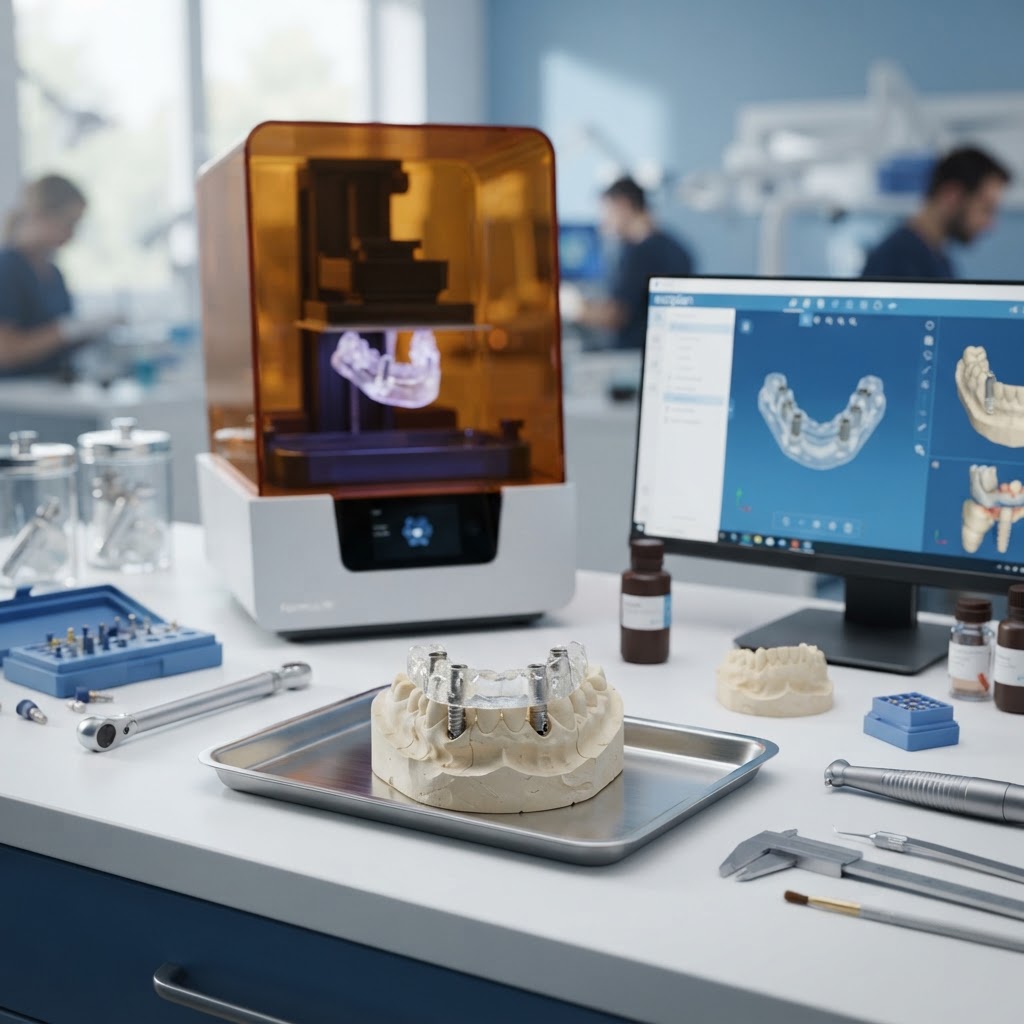
The Evolution of Implantology: From Freehand to Guided Precision
In the high-stakes arena of modern implant dentistry, the margin for error has narrowed to a degree that was once unthinkable. As we move further into 2026, the transition from freehand implant placement to fully guided workflows is no longer a luxury for boutique practices; it is a clinical standard for safety, predictability, and prosthetic-driven outcomes. However, the efficacy of guided surgery is entirely dependent on one factor: accuracy. A surgical guide is only as good as the data, design, and manufacturing process behind it. For the modern dental laboratory and clinician, understanding the nuances of surgical guide printing accuracy and digital workflow integration is paramount to delivering elite patient care.
The Critical Role of Accuracy in Guided Surgery
Accuracy in guided surgery is defined by the deviation between the planned implant position in the software and the actual position achieved in the bone. Deviations can occur in three dimensions: global position, depth, and angulation. Studies have shown that even a 1-degree shift at the guide sleeve can result in a significant deviation at the apex of a long implant. Achieving sub-100 micron accuracy across the entire workflow is the benchmark for success. This requires a meticulous approach to every step, from the initial intraoral scan to the final light-curing cycle of the 3D printed resin.
The Pillars of a High-Fidelity Digital Workflow
A seamless digital workflow acts as the backbone of precision. It begins with the acquisition of high-resolution data and ends with a physically stable device. The integration of these steps determines whether the final guide will fit passively or fail in the operatory.
Data Acquisition: The Synergy of IOS and CBCT
The foundation of any surgical guide is the fusion of hard and soft tissue data. Intraoral Scanners (IOS) provide the high-resolution surface detail of the dentition and mucosa (STL/PLY files), while Cone Beam Computed Tomography (CBCT) provides the underlying bone architecture and nerve pathways (DICOM files). The accuracy of this 'digital twin' depends on the calibration of both devices. Practitioners must ensure that the IOS scan captures sufficient landmarks, especially in partially edentulous cases, to allow the software to accurately 'stitch' the data sets together. Any error during this registration phase will be magnified throughout the subsequent steps.
CAD Design and Software Calibration
Once the data is merged, the virtual planning begins. Modern CAD software allows for the precise placement of virtual implants, taking into account bone density, emergence profile, and restorative requirements. During this phase, the selection of the guide sleeve is critical. The tolerance between the metal sleeve and the 3D printed guide body must be accounted for in the software settings. An overly tight fit can cause stress fractures in the resin, while an overly loose fit introduces rotational inaccuracy during drilling.
Hardware Realities: Choosing the Right 3D Printing Technology
The choice of 3D printing technology significantly impacts the dimensional stability of the surgical guide. There are three primary technologies dominating the market today:
- Stereolithography (SLA): Known for smooth surface finishes and high detail, SLA uses a laser to cure resin. While precise, it can be slower than other methods.
- Digital Light Processing (DLP): Using a projector to cure an entire layer at once, DLP offers excellent speed and highly repeatable accuracy, making it a favorite for high-volume labs.
- Liquid Crystal Display (LCD/mSLA): The most accessible technology, modern 4K and 8K LCD printers offer incredible resolution and are increasingly used for chairside guide production.
Resin Biocompatibility and Dimensional Stability
Surgical guides are Class IIa medical devices, requiring the use of biocompatible resins that can withstand the rigors of the oral environment and, in many cases, sterilization. Beyond biocompatibility, the resin must exhibit high dimensional stability. If a resin absorbs moisture or continues to shrink after printing, the guide may not fit the patient’s arch on the day of surgery. High-quality resins are formulated to maintain their shape and 'snap-fit' for weeks after production, allowing labs to ship guides across the country without fear of warping.
Mitigating Errors: Best Practices for Post-Processing
Perhaps the most overlooked aspect of surgical guide accuracy is post-processing. A guide is not finished when it leaves the printer.
- Washing: Excess resin must be removed using isopropyl alcohol (IPA) or validated cleaning solutions. Leaving uncured resin in the sleeve holes can lead to guide sleeves not seating properly.
- Drying: The guide must be completely dry before post-curing to ensure the resin reaches its full mechanical properties.
- Post-Curing: The final UV light-curing stage is where the guide achieves its biocompatibility and final hardness. Failure to follow the resin manufacturer’s specific curing time and temperature can result in a guide that is too brittle or, conversely, too soft to hold the drill sleeves securely.
Scaling Success: Integrating Guides into Laboratory Operations
For dental laboratories, integrating surgical guides into the daily workflow requires a shift toward a 'digital first' mindset. This involves investing in robust server infrastructure to handle large DICOM files and employing dedicated design technicians who understand both the clinical and technical aspects of implantology. By offering a comprehensive 'scan-to-guide' service, labs can become essential partners to their clinical clients, reducing chair time and improving surgical outcomes. Furthermore, the use of stackable guides for complex full-arch cases represents the pinnacle of digital integration, requiring perfect alignment between the base guide, the surgical guide, and the provisional prosthesis.
Conclusion: The Future of Implant Precision
The integration of high-accuracy 3D printing into the surgical workflow is transforming implant dentistry from a craft into a predictable science. By mastering the intersection of data acquisition, CAD design, and validated manufacturing protocols, dental professionals can ensure the highest levels of clinical success. As technology continues to evolve, the focus will remain on refining these workflows to be faster, more accurate, and more accessible. At Cosmetic Smile Studio, we are dedicated to staying at the forefront of this digital revolution, providing the precision tools necessary for exceptional restorative results. Is your practice ready to elevate its implant protocols? Contact our technical team today to discuss how our digital workflow can enhance your surgical outcomes.