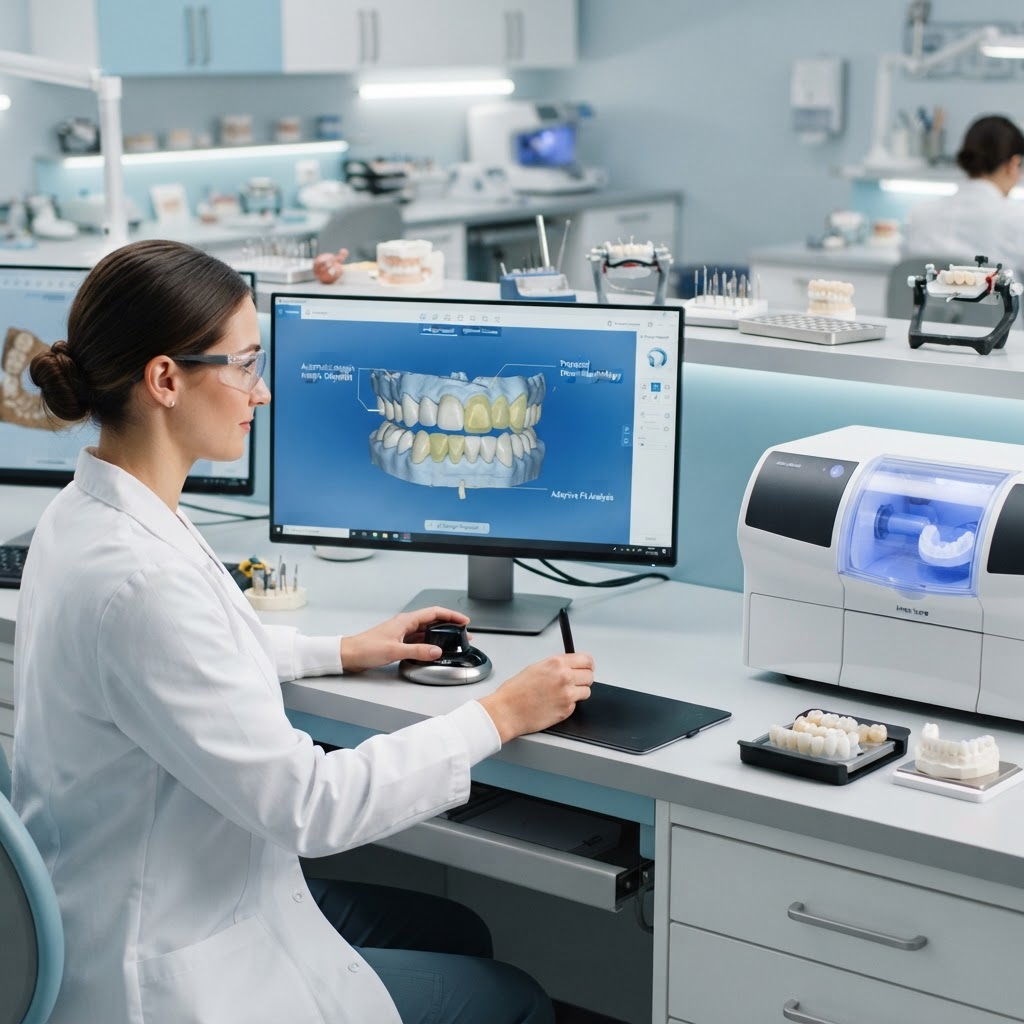
The Digital Renaissance: AI as the New Standard
The dental laboratory industry is currently navigating its most significant transformation since the introduction of CAD/CAM. While the initial digital shift replaced wax and spatulas with mice and monitors, the core design process remained labor-intensive. Today, artificial intelligence (AI) is bridging the gap between digital tools and autonomous production. By leveraging deep learning algorithms trained on millions of clinical cases, AI is not just assisting dental technicians; it is redefining the speed and accuracy of restorative dentistry. Artificial intelligence represents a paradigm shift from 'tools that we use' to 'systems that understand.' In the traditional CAD workflow, the computer was essentially a digital drawing board where the technician had to make every micro-decision regarding anatomy, occlusion, and margin placement. With the infusion of machine learning, the software now possesses a form of 'clinical intuition' derived from vast datasets of successful restorations. This allows for a more predictive rather than reactive design environment.
Automated Design: Beyond Traditional CAD
Traditional CAD workflows require technicians to manually identify margin lines, orient scan data, and sculpt tooth anatomy. AI-powered design software, however, can perform these tasks in a fraction of the time. Key advancements include:
- Auto-Margin Detection: High-precision algorithms analyze the prep geometry to identify the finish line with sub-micron accuracy, significantly reducing the risk of fit issues. This removes one of the most common points of human error in the design phase.
- Morphological Prediction: By analyzing the patient's existing dentition and the antagonist's occlusal pattern, AI suggests a restoration shape that harmonizes perfectly with the natural anatomy. This goes beyond standard library-based design by learning aesthetic nuances.
- Nesting and Support Optimization: Beyond design, AI optimizes the placement of restorations in 3D printing or milling blanks, maximizing material efficiency and reducing post-processing labor.
The Power of Neural Networks in Dental CAD
The core of AI in dental labs lies in convolutional neural networks (CNNs). These networks are trained on hundreds of thousands of STL files and clinical cases. When a technician uploads a new scan, the AI compares the unique geometry of that patient to its entire database. It recognizes the tooth number, the preparation style, and the relationship with neighboring teeth. This allows the software to propose a design that is nearly complete upon the first click. For the modern lab, this means the design phase for a single posterior crown can drop from ten minutes to under sixty seconds, drastically increasing throughput.
Enhancing the Lab-Clinic Relationship
One of the most profound impacts of AI is its ability to serve as a bridge between the clinical operatory and the laboratory bench. In the past, a lab might receive a scan only to find that the preparation lacked sufficient occlusal clearance or the margins were obscured. AI-enabled intraoral scanners and lab software now provide real-time scan quality assessments. This proactive approach ensures that the data leaving the dental office is perfect, which virtually eliminates the frustration of 'on-hold' cases and design guesswork. Furthermore, AI-driven smile design tools allow clinicians to show patients a highly realistic simulation of their final result before a single tooth is prepped, boosting case acceptance and ensuring clinical goals are aligned.
Practical ROI: Why Labs Should Invest Now
For lab owners, the move toward AI design is driven by more than just innovation; it is a vital business strategy. The primary benefits include:
- Operational Scalability: Labs can handle significantly higher volumes of work without increasing their technician headcount. This is critical in an era where skilled labor is increasingly difficult to find and retain.
- Enhanced Consistency: Human fatigue is a factor in any laboratory setting. AI maintains a standardized baseline of quality 24/7, ensuring that the tenth case of the day is as precise as the first.
- Elevated Artistry: By automating routine single-unit cases, master technicians are freed to focus their expertise on complex, high-aesthetic cases—such as anterior veneers and full-arch rehabilitations—that still benefit from the nuance of human creativity.
The Future: Generative AI and Beyond
As we look toward the future of 2026 and beyond, we are seeing the rise of generative AI. Unlike current systems that select from a library, generative models can invent unique tooth forms that optimize both strength and beauty based on the specific material properties of the zirconia or resin being used. This level of customization was previously impossible. We are also seeing AI integrate with the physical hardware of the lab, where mills and printers use sensors to adjust their parameters in real-time based on AI-driven performance data. This total integration marks the beginning of the 'smart lab' era.
Conclusion
The integration of AI into dental CAD/CAM is not about replacing the technician, but about augmenting their capability and ensuring the highest possible quality for the patient. By adopting these technologies, labs can provide faster, more precise, and more affordable restorations while maintaining healthy business margins. As the technology continues to evolve, staying ahead of the curve will differentiate premium dental laboratories from their competitors. Ready to transform your workflow with the power of intelligence? Contact Cosmetic Smile Studio today to learn how our AI-integrated lab services can elevate your practice and provide the precision your patients deserve.