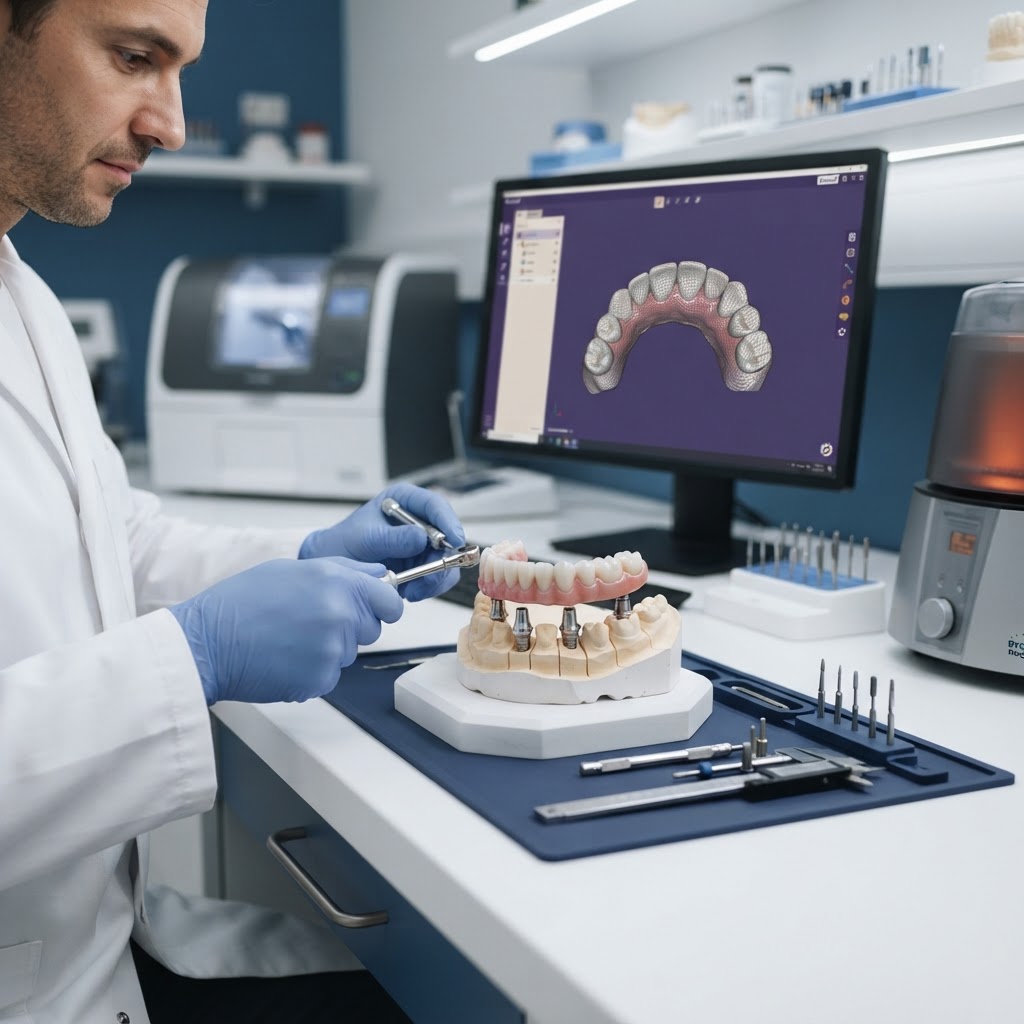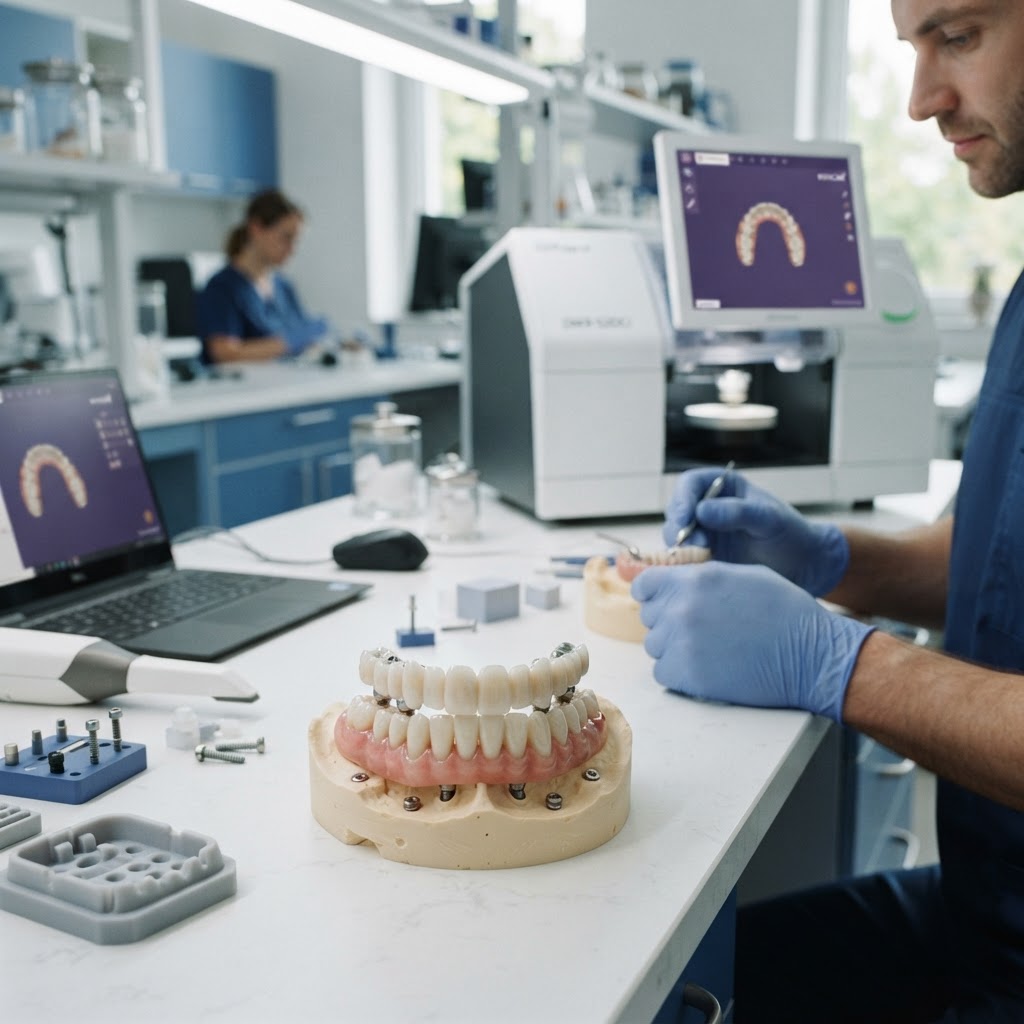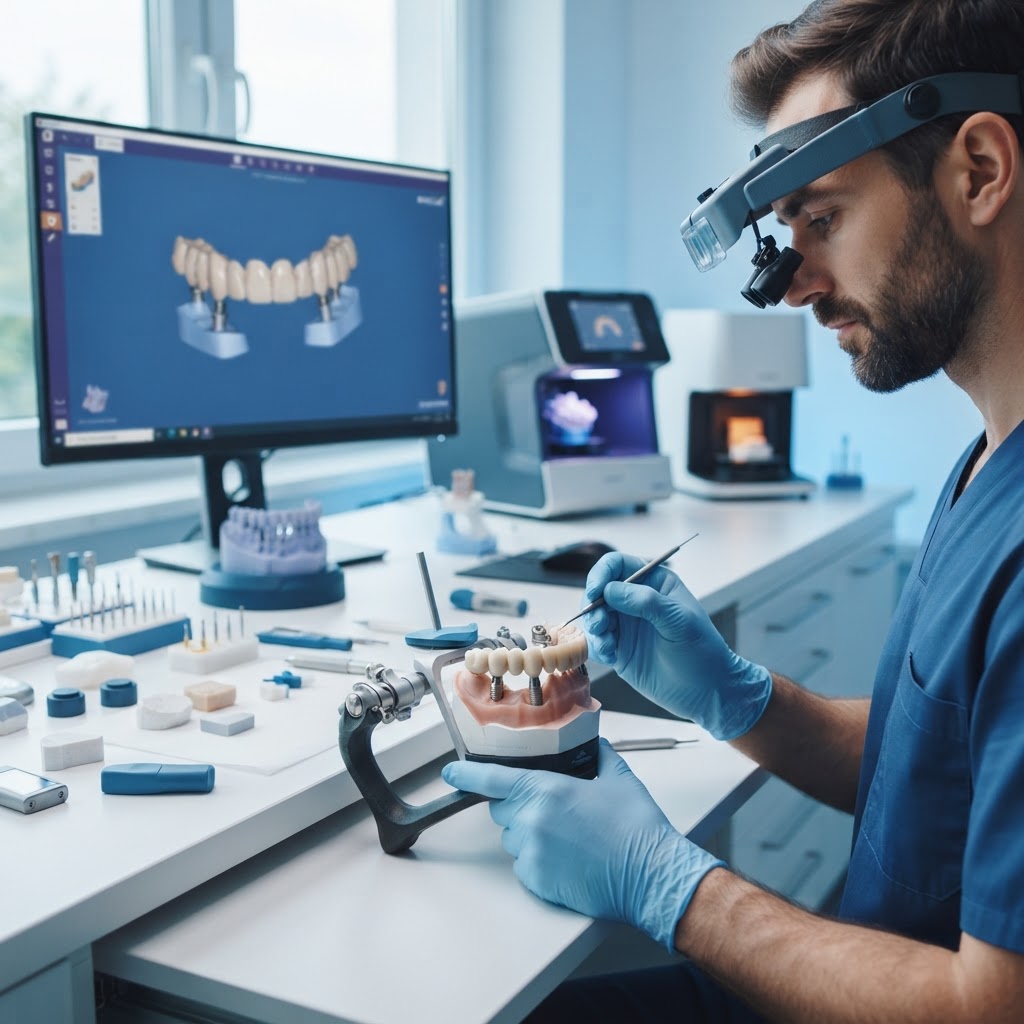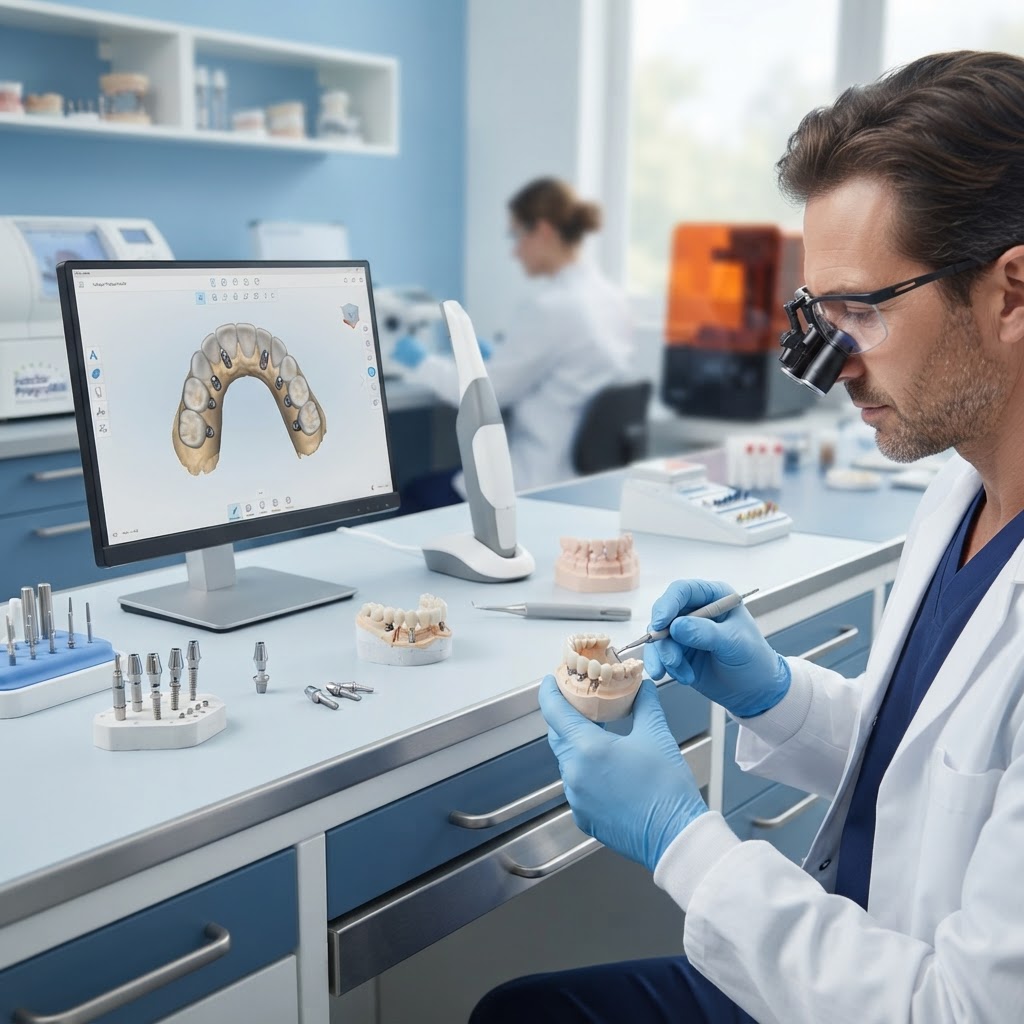
Full-arch implant rehabilitation has entered a transformative era. Historically, treating the edentulous or terminally dentate arch required extensive chairside conversions, multi-stage open-tray analog impressions, and cumbersome verification jigs. Today, restorative teams are shifting toward streamlined, fully digitized ecosystems that combine prosthetic-driven surgical planning with cutting-edge biomaterials. For dental laboratories and restorative clinicians, mastering these converging innovations is essential to delivering superior aesthetics, absolute passive fit, and long-term biomechanical stability.
The Evolution of Full-Arch Prosthetic Materials
Material science continues to advance at a rapid pace, addressing the age-old dilemma of full-arch dentistry: balancing exceptional structural strength with physiological shock absorption and lifelike aesthetics.
High-Translucency and Multilayered Monolithic Zirconia
Monolithic zirconia remains the gold standard for final full-arch prosthetics, primarily due to its exceptional biocompatibility, wear resistance, and elimination of the chipping issues common in porcelain-fused-to-metal (PFM) or acrylic-on-titanium hybrids. Modern formulations utilize 3Y-TZP high-strength cores transitioning to 4Y-TZP or 5Y-TZP in the incisal zones. This gradient delivers fracture toughness exceeding 1,000 MPa at critical cross-sections while preserving natural optical translucency across the smile zone.
High-Performance Polymers: PEEK, PEKK, and Graphene
While monolithic zirconia dominates, high-performance polyaromatic polymers like PEEK (polyetheretherketone) and PEKK (polyetherketoneketone) have become increasingly relevant. These polymers boast an elastic modulus closer to human cortical bone (3–5 GPa), absorbing occlusal shock and dampening stress transferred to the bone-implant interface. Often wrapped in biocompatible composite or paired with individual CAD/CAM ceramic crowns, polymer frameworks offer a lighter, serviceable alternative, especially for heavy bruxers or opposing full-zirconia arches.
Next-Generation 3D Printable Polymers
Long gone are the days of brittle, hand-relined provisional acrylics. Current nanohybrid, ceramic-filled printable resins now offer flexural strengths exceeding 130 MPa. These materials empower teams to 3D print long-term provisionals directly on day of surgery or deliver immediate try-ins within hours, verifying phonetics, occlusal vertical dimension (OVD), and lip support before committing to the final milled prosthesis.
Transformative Digital Workflows: From Data Acquisition to Surgery
Predictable full-arch outcomes begin long before the patient enters the operatory. Modern workflows rely on seamless data merging that links surgical placement directly to the ultimate aesthetic smile design.
- Comprehensive Diagnostic Merging: Aligning high-resolution CBCT bone data, dynamic intraoral scans (IOS), and 3D facial scans allows the restorative team to evaluate bone volume in relationship to the final facial midline, lip dynamics, and plane of occlusion.
- Stackable Surgical Guides: Advanced guide systems utilize bone-anchored base rings paired with modular, magnetically seated components. This allows clinicians to execute bone reduction, precise osteotomies, guided implant delivery, and immediate provisional seating using a single reference coordinate system.
- Prosthetic-Driven Angulation: By designing the prosthetic envelope first, implant angulation can be optimized to exit through cingulum and central fossa positions, maximizing multi-unit abutment (MUA) efficiency and avoiding buccal screw channels.
Overcoming the Passive Fit Dilemma: Photogrammetry and Scanning
Achieving a completely passive fit across four to six implants has historically challenged conventional intraoral scanners due to cumulative stitching errors across broad, edentulous spans. Recent innovations have dismantled this hurdle.
The Role of Photogrammetry
Photogrammetry systems capture three-dimensional implant positions using specialized optical targets and multi-camera arrays. By measuring the absolute spatial coordinates and angles of the implants independently of soft tissue movement, photogrammetry generates an ultra-precise geometric file (.STL or text coordinates). When merged with an intraoral scan of the soft-tissue architecture, labs can design full-arch frameworks that seat with zero mechanical strain on the implants.
Optimized Intraoral Scanning Protocols
For practices utilizing standard intraoral scanners, validated scanning strategies—such as continuous splinted scan bodies, auxiliary geometric landmarks on the palate, and specialized cross-arch scanning patterns—now achieve repeatable precision that rivals traditional verification jigs.
Practical Implementation for Labs and Practices
Successfully transitioning to a digital full-arch workflow requires disciplined collaboration between the surgical operatory, the restorative clinician, and the dental laboratory:
- Standardize on Multi-Unit Abutments: Moving the restorative platform away from the fixture level simplifies hygiene, standardizes screw geometry, and mitigates angle discrepancies, creating an ideal passive pathway for CAD/CAM superstructures.
- Preserve the Digital Record: When a provisional restoration functions well mechanically and aesthetically, re-scan it as a pre-op template. The lab can duplicate this validated envelope into the final monolithic zirconia structure with negligible manual adjustment.
- Invest in Continuous Team Training: Fully digital protocols reduce chairside steps, but require rigorous attention to digital scan calibration, bite registration capture at the proper vertical dimension, and software familiarity across both clinical and laboratory teams.
Conclusion: Elevating Full-Arch Excellence
The convergence of biocompatible monolithic materials, digital photogrammetry, and prosthetic-driven planning has elevated full-arch rehabilitation to unprecedented heights of predictability and precision. By removing analog guesswork, dental professionals can deliver restorations that satisfy aesthetic expectations while ensuring long-term structural success.
Ready to elevate your full-arch cases? Connect with the digital design team at Cosmetic Smile Studio today to explore our advanced milling, guided surgery, and full-arch restorative support.